
© Loic Benoit
Cinema for all
The Lumière film festival in healthcare facilities
The festival is not always confined to movie theaters and reception venues — it also travels to those who are unable to attend.
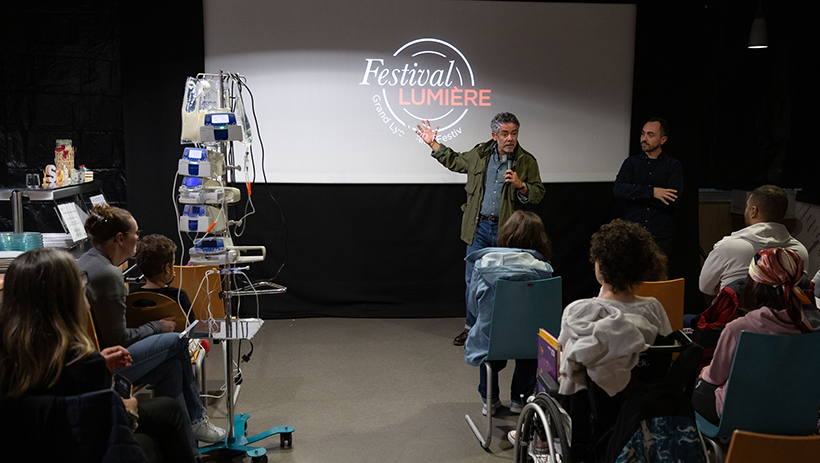
Each year, a festival guest visits a healthcare establishment to introduce a screening and lead a discussion with patients and residents. This moment of sharing and passing on knowledge allows these audiences to enjoy the festival too.
Since 2016, certain patients and care teams have also been able to “attend” the festival's major events and interact with guests thanks to a telepresence robot.
These screenings are specifically organized at:
- The Hôpital Femme-Mère-Enfant in Bron
- EHPAD retirement homes, with support from Apicil's Action Sociale Retraite
- The Institut d'Hématologie et d'Oncologie Pédiatrique at the Centre Léon Bérard
- The Clinique Saint-Vincent-de-Paul in Bron.
The Lumière film festival in prisons
In 2012, Emmanuelle Devos inaugurated the idea, introducing a festival film at the Lyon-Corbas detention center. Since then, every year, various cinema personalities have joined the program, with the aim of generating dialogue and sharing great œuvres of cinema.
From one edition to another, the action has gradually expanded to include other detention centers, resulting in the films being broadcast on the television network of nine prisons across the Auvergne-Rhône-Alpes Region.
Improving accessibility of screenings
The festival endeavors to make its screenings accessible to audiences with disabilities.
To allow as many people as possible to enjoy the works presented, certain screenings
offer adapted formats. In 2025, for instance, there were:
- 5 screenings with SME subtitles (for deaf and hard-of-hearing audiences)
- 1 screening in VAST format (audio-subtitled version — spoken subtitles delivered through headphones for blind, low-vision, or dyslexic audiences).
Promoting inclusive access to culture
The Lumière film festival is a celebration of cinema open to all.
Through invitations and preferential rates, the festival supports audiences who don't usually have access to cultural events, facilitating their participation.
These audiences may include:
- children and families in vulnerable situations
- residents of supported housing facilities
- newcomers
- young people who are unemployed or in reintegration programs
- people living with dependency or disability
- students.
Because cinema is a shared heritage, the festival is committed to making it accessible to as many people as possible.