
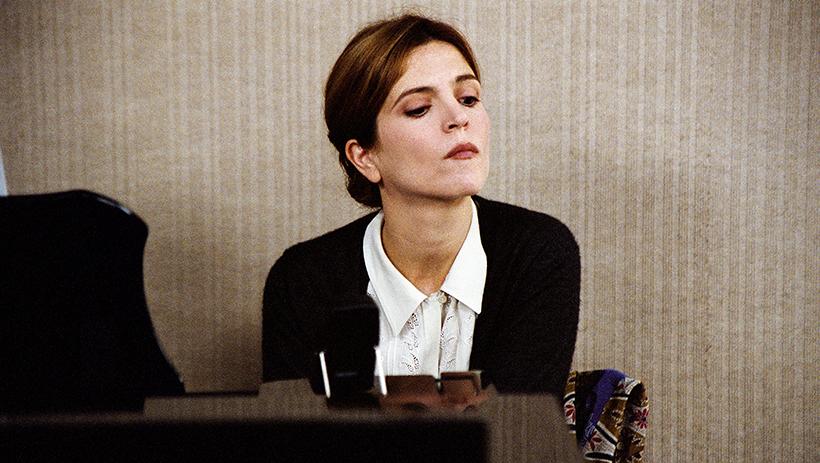
© Films A4 / DR
THE FILM PASSION OF…
A real taste of others
POSTED ON 12.10.2026
Agnès Jaoui joins us to evoke her love of cinema, providing the perfect opportunity to take a closer look at her films!
From her débuts with Jean-Pierre Bacri until this year’s Crescendo, Agnès Jaoui has constantly addressed power dynamics, petty cowardice, shame, the craving for acknowledgment and our difficulty in accepting that others are not like us.
In her films, people speak a great deal. The setting is less relevant, as long as the characters can express themselves freely. Discussions might happen around a table, in a café or on an opera stage. They talk at length, yet rarely listen to one another, which leads to eventual betrayals, like in Kitchen with Apartment, a hugely successful play in 1991 before it was adapted for the big screen.
In 1996, Family Resemblances sets a high bar for screenwriting as an even more finely sketched comedy, co-written again with Jean-Pierre Bacri and directed by Cédric Klapisch. In a bistro where a family gathers, each person arrives with their own masked grudges and ends up being the target of the others’ jokes, depending on the roles they’ve designated for themselves. No one is outwardly malicious, but everyone is capable of cruelty.
In The Taste of Others (2000), Jaoui’s first foray into directing, she takes the concept a step further. Castella (played by a heartbreaking Bacri), an “uncultured” boss who falls in love with an actress, discovers a world whose rules of the game have eluded him. Yet the filmmaker doesn’t simply hand out good or bad marks as one might expect; here, the “learned” ones can reveal themselves be far more lacking than the supposedly “uncouth” or those deemed as such. “Accepting others is a lifelong journey,” she told Psychologies in 2009. The Taste of Others is Jaoui’s most heartwarming–and perhaps most subversive–work in her filmography.
Look at Me (2004) prompts Jaoui to shift her focus of observation toward a more intimate, narrow context. Lolita, the daughter of a famous writer, acutely seeks the approval of her father, who is pathologically egocentric. The director touches on a theme that runs through her writing: why do we so desperately need others to send back to us a flattering image of ourselves? She willingly endorses psychoanalysis as a framework for interpretation, calling it “the best screenwriting school there is.” A line in the film perfectly sums up this vision: “We think we love people for who they are, but we also love them for who they make us believe we are.” Agnes Jaoui’s cinema is never particularly gentle with her characters, but they eventually gain grace; she grants them room to be contradictory… and to make mistakes.
In Crescendo, which screened at Cannes this year, she has transposed her own style into the world of an opera, presenting a troupe with power struggles and an accusation of sexual assault. As the community begins to crack, individual members realize that not everyone shares the same definition of right and wrong. “When everyone has their own idea of what’s right, cacophony ensues,” she explains in the preamble to this wonderful comedy. The metaphor is anything but arbitrary–Jaoui holds an understanding of music, having studied opera at age sixteen. When our mindsets aren’t in harmony, it is hard to make them sing on key for us, she says succinctly. The work is dedicated to Bacri, and Jaoui has not attempted to recreate what they’d accomplished so beautifully together. She continues the conversation solo, voicing the same concerns. This does not prevent her filmmaking from remaining, above all, a collaborative endeavor.
Carlos Gomez