
© Rudy Bou Chebel - Les Films des Tournelles / DR
SOLIDARITY
« Cultural Resistance! »
POSTED ON 15.10.2026
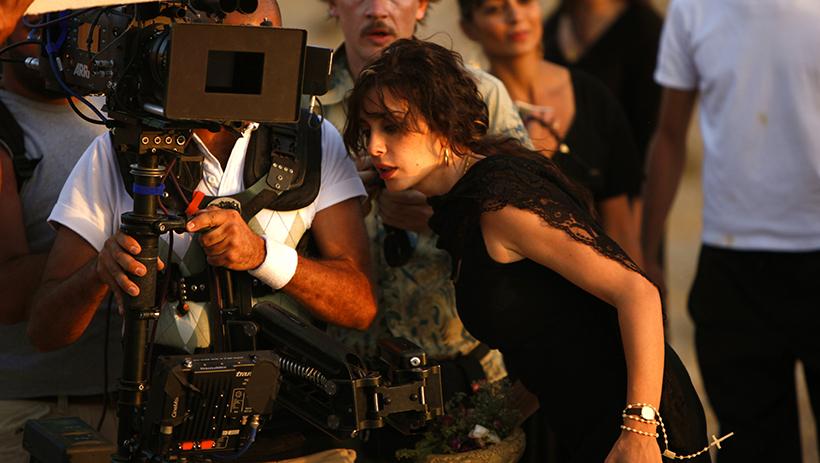
She has lived through cinema amid the bombs and transformed it into a non-violent weapon. From Caramelto Capernaum, the Lebanese filmmaker and actress portrays what the world would rather not see, without ever forgoing the sense of entertainment.
Nadine Labaki began by fleeing–not from Lebanon, but from reality. As a child, she grew up during the civil war and discovered movies the way one discovers a secret passage. “In my village,” she explained to Gala in 2019, “we were lucky enough to live above a store that rented VHS cassettes, so when the shooting stopped and the power came back on, we’d go downstairs and choose one. Often the same film, because the selection was limited to Grease and The Under-Gifted, which we must have watched a thousand times!” These movies allowed her to leave the bomb shelters behind and temporarily forget about the sandbags. Until she came to the realization that “telling my own stories would be the most effective way to create worlds far removed from my own.”
In Caramel (2007), her first feature film, five women find themselves in a beauty salon in Beirut, chatting about waxing, desire, marriage, homosexuality… Beneath the glossy veneer of melodrama, Labaki was already beginning to stand up for those who were spoken of behind closed doors. A début feature produced by Anne-Dominique Toussaint, who, while visiting Beirut, encouraged her: “Write, tell your stories. I’ll support you.”
In Where Do We Go Now? (2011), Nadine takes things a step further: in a Lebanese village torn apart by religious differences, the women band together to stop the men from starting the war again. The cause is a serious one, but the method? Not so much. According to Labaki, fanaticism can be defeated with lies, dances and a few sedatives! Delightful.
Then came Capernaum (2018), where her plea took the form of a court case. She spent four years doing research in children’s courts, meeting families and asking children a simple yet profound question: “Are you happy to have been born?” One evening in 2014, after seeing a mother and her baby on the highway, frantic between two high-speed roads, she returned home and sketched the face of a young Syrian boy named Zain, who, in the story, will proclaim his misery openly to the adults, even suing his parents for bringing him into the world. It is the first of her films in which Nadine elected not to appear.
However, she rejects cinema that assigns good and bad grades. She says she wanted to “shake up the audience’s clear conscience” before realizing, through her interactions with the families, that she herself had “no right to judge them.” To hold a society accountable without exempting oneself requires elegance and dignity. “I cannot remain silent; otherwise, I am complicit in the crime.”
Her work thus prioritizes faces over slogans, seeks out contradictions, and, above all, places doubt on certainties. Emotion arises through the intervals. In 2024, she summarized her method this way: “I try to [...] develop my stories in such a way that I am the ‘vehicle’ that will carry their struggles forward.” And, above all, my films will give them the last word.” In Lebanon, which she refuses to abandon, she is now calling for “cultural resistance,” her weapon of choice, which will always consist of two short hours of fiction.
Carlos Gomez