
© Loic Benoit - Institut Lumière
MASTER CLASS
« I see the camera more as a partner. »
POSTED ON 13.10.2026
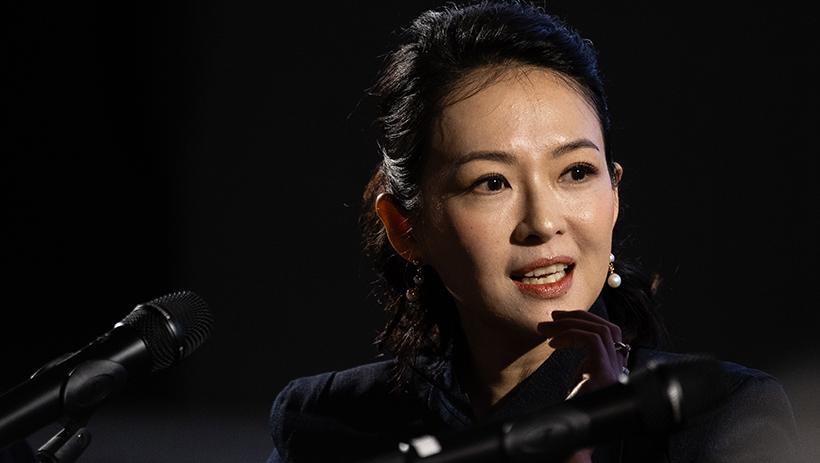
Chinese actress and director Zhang Ziyi is not afraid of silence or emptiness on the screen… Further explanations...
DIRECTING
I never really learned how to make films, so by the time I actually started out, I didn’t have a very good grasp of all the techniques used by cinematographers. But I was lucky enough to have worked with some great directors as an actress. The way I grew and progressed alongside them helped me tremendously. Lighting has always been crucial for Wong Kar-Wai and Ang Lee...
PATIENCE IS A VIRTUE
Directing children was one of the trickiest things about being a director. I’m glad I got to meet this little troupe of bright, adorable children… but they were also quite a handful! Patience is a virtue: you have to assume you’ll probably need about fifty takes, rather than ten, especially when the little actors forget their lines. Fortunately, as a mom of two myself, I knew how to adapt. Things went even better when I gave them sweets and ice cream, though that probably wouldn’t work with adult actors!
SHE’S VERY DANGEROUS
My character in Wo hu cang long/Crouching Tiger, Hidden Dragon has a lot of courage, confidence, a sense of adventure and keen observation skills, qualities that we might all envy to some extent. But in my view, that’s why the audience loves her. She’s very dangerous, but it’s an appealing sort of danger, because she is challenging the status quo. Even though it’s a historical film, the character remains very modern. Especially if you consider it’s a film from 20 years ago, and featuring an Asian actress. But when it comes down to it, the only reason I accepted the role was because Ang Lee offered it to me!
EMPTINESS
What stands out about Chinese films is that emotions are portrayed with great restraint. What we’re trying to achieve in our films is a sense of emptiness. And the master of this is Wong Kar-Wai. In The Grandmaster, in fact, there’s a lot of emptiness. And that emptiness, that void, that blank space, gives a vast imaginative space to the viewer. When I’m faced with that kind of scene, I find it rather exciting. The camera is a cold, mechanical object. When an actor finds themselves facing the lens, they can feel intimidated. I, on the other hand, see the camera more as a partner. On screen, I seem calm and in control, but in reality, my mind is a whirlwind of emotions! It’s through the eyes and the gaze that we fill this void when emotions are not visible. The real challenge is to understand the power and strength that lie behind the camera and the image.
TONY LEUNG
The first time I worked with him, it was on Hero by Zhang Yimou (2003). Then there was 2046 (2004) and The Grandmaster (2013) by Wong Kar-Wai. Working with him gives me a sense of security. For example, on 2046, it was a good thing he was there, because I was starting to doubt myself, and to even doubt life itself! Since then, a very strong bond of trust has developed between us. In real life, he’s a very gentle person, a man of few words, but he is still capable of playing the villain. If I’ve had the good fortune to win awards, it’s probably largely thanks to Tony Leung. In my heart of hearts, he will forever remain the greatest actor!
Interview by Fanny Bellocq