
© Léa Rener - Institut Lumière
MASTER CLASS
« If you’re working on a movie, whenever you can break a rule, do it! ! »
POSTED ON 17.10.2026
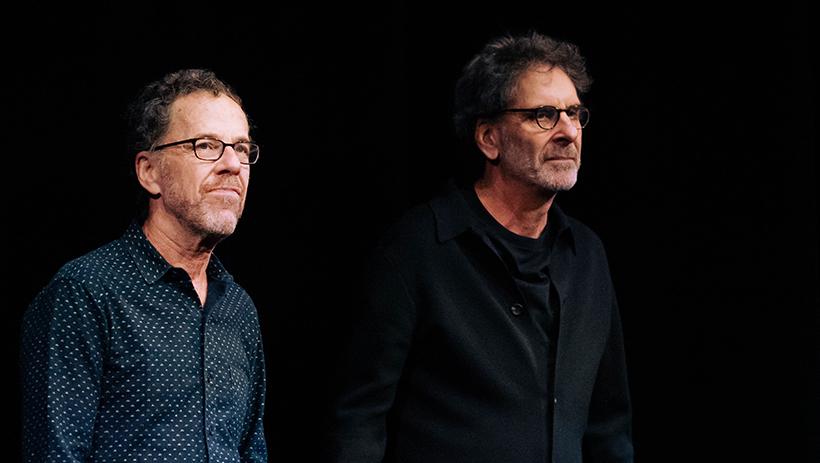
Joel and Ethan Coen delivered a deadpan master class of supreme serenity and remarkable depth.
ONCE UPON A TIME…
Joel Coen : We grew up in Minnesota, “in the middle of nowhere, USA.” Our mother was from London, and our father taught at the university. I remember often asking him, “But what are we doing here?”
Ethan Coen : Movies offered us a means of escape. We developed our love of film mostly thanks to the University of Minnesota movie club, which introduced us to films that weren’t broadcast on TV.
TWO-MINUTE TRIALS
E.C. : As kids, we used to shoot two-minute films of really bad horror movies. We learned one essential lesson: editing can save a lot of things.
J.C. : Basically, we didn’t really know what editing was. To make a transitional cut, we’d stop a scene, switch to a different frame and place, and then return to the original setting. Afterwards, we’d mail it to the lab, and the great thing was that when the film came back, it was done! I started out as an assistant editor, mostly on terrible B-movies. Then I encouraged Ethan to write stories so we could work together. We loved horror movies such as Sam Raimi’s The Texas Chainsaw Massacre, but we had other ideas in mind.
TWO BROTHERS, A SINGLE MIND
E.C. : We write together, then we choose the cast and crew together. And we test out our ideas to see how good they are based on how the other reacts.
J.C.: Sometimes we challenge each other. One day, we said to ourselves, “We’d never start a movie with a title card that reads, in typewriter font, ‘CIA, CIA Office, 1950.’” Then we looked at each other and said, “Why not open our next movie with that?”
E.C. : We have no problem accepting ideas from outside, including ones we had originally rejected. With Carter Burwell, sometimes we’d describe a piece of music by explaining what it definitely shouldn’t sound like… and then he’d end up doing exactly that, and we’d love the result! Sometimes a mistake turns out to be a blessing in disguise.
LIKING THE ACTORS
J.C. : Our first actors were our college friends. We have a pretty hands-off directing style: we explain the tone of the film, give them the script, and let them find their own way.
THE MOST IMPORTANT FILM
J.C. : With your first film, you learn everything, discover your own way of working, and learn lessons that shape you for the rest of your life. In that sense, Blood for Blood remains my favorite. But my happiest memories are also tied to the atmosphere created with the music playing on set as we filmed, which is The Big Lebowski.
E.C. : O Brother, Where Art Thou ?, which reminds me of our childhood. Hearing live music during takes transforms the whole experience of filming.
LE FILM CASSE-TÊTE
J.C.: Miller’s Crossing. It was an adaptation of a story by Dashiell Hammett, and we were really having a hard time with the structure. We decided to take a three-week break, and in that interim, we wrote Barton Fink. It’s the story of a guy who can’t seem to write!
YES, WE CANNES.
E.C. : Seeing your film screened at Cannes (the Coens won the 1991 Palme d’Or for Barton Fink) already gives a huge boost to your future career. Awards are just the icing on the cake.
J.C. : That reminds me of a joke about an aging Billy Wilder who went to see a doctor because he was having trouble urinating. The doctor asked him, “How old are you?” Wilder replied, “75.” And the doctor said, “You’ve peed enough in your life.”
E.C. : Actually, with this Lumière Award, you seem to be telling us, “You’ve peed enough!”
RULES? WHAT RULES ?
E.C. : We welcome a certain naiveté when it comes to the rules of filmmaking. We learned by watching movies, without ever fully internalizing the rules. Filming Inside Llewyn Davis, we even broke the 180-degree rule (which ensures spatial continuity between two shots -editor’s note). And no one even noticed.
J.C. : If you’re working on a movie, whenever you can break a rule, do it!
— Reported by Carlos Gomez