
© DR
NEW RESTORATION
Ken Russell’s the Devils
POSTED ON 12.10.2026
“I am beautiful! I am beautiful!” screams Jeanne, the hunchbacked nun, half-naked, spinning with madness amid the jeering, mocking crowd. This is Ken Russell’s the Devils, an œuvre that perfectly lives up to its title, for it is truly formidable, as is the story of its creation!
Cut, censored, and then finally banned, this 1971 historical film by British director Ken Russell is, in his own words: “a hard film about a hard subject.” What does it entail? In 1634, an envoy from the powerful Cardinal Richelieu arrives in Loudun, where, it is said, scandalous morals reign with the blessing of a man of the church, Urbain Grandier, the object of Sister Jeanne’s obsession. The issue for the authorities, who are anything but tolerant, is that they take a very dim view of this town, which has proclaimed freedom of both sexual and religious thought. Catholics and Protestants alike enjoy themselves in hedonistic harmony, with violence and a touch of sadism.
Ken Russell's the Devils is built on many layers: the play by John Whiting (1962) was itself inspired by an essay by Aldous Huxley, The Devils of Loudun (1952), which in turn was inspired by the real-life historical phenomenon of the possessed beings of Loudun, France. For the motion picture, United Artists signed on with Ken Russell, whom they actively sought out. He was THE British filmmaker of the moment. He had read the story, declared he was shocked and wanted to shock others as well by directing it. The aim was not to make an anticlerical film, but rather to tackle, more generally, the issue of manipulative control and brainwashing that certain charismatic individuals can exert over others.
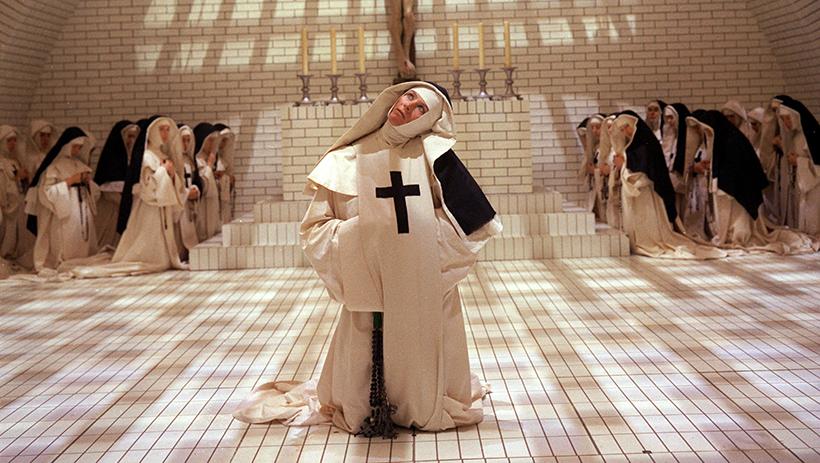
In 1970, most of the filming took place at Pinewood Studios in England, with the fantastic Derek Jarman serving as art director… in his first cinematic experience! Aesthetically, the film is wild. Bleached, white hues abound, according to Russell, an “ultra-resilient leitmotif that, through sheer quantity, ultimately dissolves human relationships!” Jarman transposes Huxley’s metaphor, for whom this story of the possessed is akin to “a rape in a public restroom.” It takes cues from Dreyer’s The Passion of Joan of Arc, an ironic muse, however, given that The Devils contains scenes of orgies and torture.
Actors Vanessa Redgrave and Oliver Reed fully commit to their roles. Reed defends the film with humor, saying “We never set out to make a nice, Christian movie. Charlton Heston has done enough of those. The Devils is about twisted people!” Upon its release, the British Board of Censors ordered scenes to be cut and classified the film as X-rated (prohibited to those under 18); the United States did the same. Other countries banned it outright, including Finland, where it remained forbidden… until 2001! The Vatican demanded that it be withdrawn from screenings at the Venice Film Festival. The film’s reception was mostly negative, with many put off by the “Grand Guignol” style spectacle, although a few appreciated the artistry of its horrific grotesquery. In British theaters, however, it was a hit.
Thus began a long, arduous journey to restore the film to its original form and an authentic version! It underwent an initial restoration and was screened in London in 2002. In 2014, filmmakers such as Guillermo del Toro got on board for the campaign to support the film, #FreeTheDevils, to make it more accessible. In 2026, Clockwork, the brand-new specialty label of Warner Bros. released a 4K director’s cut based on an original negative, featuring the deleted scenes that no one had seen in 50 years. The matter is finally resolved!
Virginie Apiou