
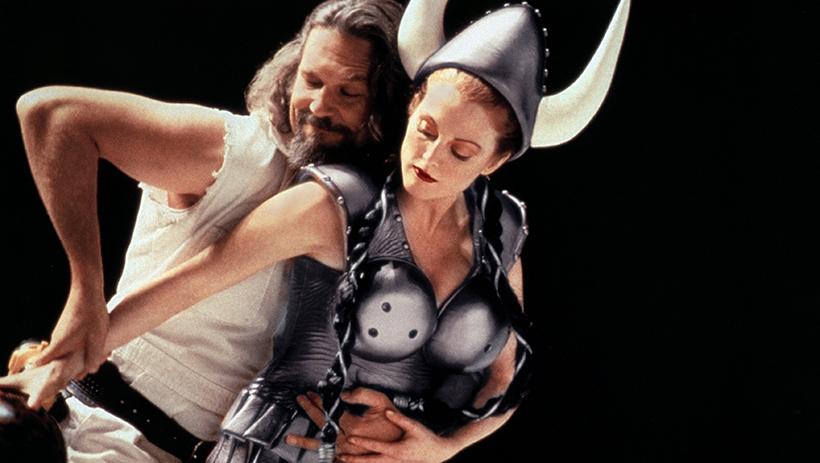
© Polygram - Working Title / DR
CLOSING CEREMONY
Lebowski: An alternative art de vivre!
POSTED ON 18.10.2026
A bathrobe, an old rug and bowling buddies all play a part in the success of a film that upends the rules of film noir.
There are basically three ways to describe The Big Lebowski. The first would be to recite–and reenact–the best lines: “Nobody calls me Lebowski. You got the wrong guy. I’m the Dude, man!” The second would be to pitch the movie in an annoying and esoteric fashion: “So basically, like, it’s the story about this super dirty rug , man, that goes missing from the living room, of this guy who doesn’t get it, right?” If that doesn’t work, a third, surefire shot would be to distribute the recipe for the White Russian that The Dude sips as soon as he wakes up… However, the Coen brothers’ seventh feature, released in 1998, two years after Fargo, deserves far more than that. The riotous comedy subverts the norms of the crime genre, resulting in a portrait of America where a glorious loser becomes a figure of resistance against the powers that be, unbeknownst to him. Ultimately, it’s a film through which a considerable number of fans have identified a new art de vivre… in a bathrobe.
The idea comes in part from the skilled pen of Raymond Chandler, but it doesn’t exactly make it a detective film. Lebowski—aka Jeff Bridges–is a deadbeat pothead “who’s starting to get up there in years,” as Ethan Coen explained to the Los Angeles Times in 1998. Ethan and brother Joel take the film noir playbook and tear out its pages, starting with a ransom request that involves gangsters, a millionaire and the Dude’s fellow bowlers. Stating that the plot is convoluted is an understatement. But it’s all on purpose, so that the guy in the middle of the screen–clad in rags and sandals—seems the least equipped to handle it.
Upon its release, the Coens had already won an Academy Award a year earlier for Fargo, but The Big Lebowski didn’t live up to their expectations. Jeff Bridges, for one, admitted being “a little disappointed;” he was sure that audiences would love this crazy film. But no one could have foretold the phenomenon that would unfold, one that would give rise to “Lebowski Fests” across the US and make the Dude resuscitate his now-iconic outfit for commercials and TV appearances.
The Big Lebowski, inspired by a real-life figure, producer Jeff Dowd, who helped the Coens when they were starting out, thus occupies a unique spot in the Coen canon. After the bleakly cynical Fargo, the duo wanted to take it further with their penchant for chaos, quirky characters and plot twists that unravel just when you think you’ve caught on. Dude, Walter (John Goodman), a Vietnam vet who settles everything with anger and Donny (Steve Buscemi), who is constantly being told to shut up, form a comedic trio whose chemistry is bonded by the intricacy of the dialogue and their natural performances. So it’s somewhat surprising to learn, as John Goodman disclosed, “The lines seemed improvised, but they never were.” How did Dude become a cult figure? It must be his skill in transforming inaction into a whole philosophy. He is not seeking success or dominance; he just wants to be refunded for his rug, “which made the whole room.” In America, a country still defined by the pursuit of performance, his ability to resist getting caught up in the rat race undoubtedly retains a certain welcome note of defiance.
— Carlos Gomez