
© DR
RETROSPECTIVE
Norman Jewison, the Impatient Auteur!
POSTED ON 12.10.2026
Norman Jewison claimed he liked to wrap up his movies quickly out of impatience, and this way, he never went over budget. He also said of himself, “I’m very lazy. I wait for the scene, the location and the actors to inspire me.” Behind this impatience and this (feigned) laziness, hid an accessible, eclectic and lyrically epic filmmaker… a true genius!
MUSIC
Born in 1926 and deceased in 2024 in Canada, Jewison cultivated his artistic vision while working in American and British television. In 1951, he wrote, directed and produced mostly musical TV programs. By 1958, NBC had entrusted him with the show that would signal the much-awaited comeback of iconic actress and singer Judy Garland. From this experience, he developed a sense of rhythm that would later contribute to the success of his musical pictures, including Fiddler on the Roof (1971) and Jesus Christ Superstar (1973).
COMEDY
Rhythm and pace are also key in humor! Jewison began his film career in comedies, thanks to Tony Curtis, who engaged him to direct The Trouble with Harry in 1962, the same year the former founded his independent company, Simkoe Productions. “Comedy is a much more delicate genre than the others,” Jewison remarked in 1970, whether it was an effervescent romantic comedy Don’t Send Me Flowers (1964), a satirical piece The Russians Are Coming the Russians Are Coming (1966) or a movie of pure charm, Moonstruck (1987)!
MAVERICK
With a degree in English and philosophy and a deep love of cinema, Jewison directed 24 films between 1962 and 2003. Although he was also a screenwriter, he disliked writing solo. A secret, masculine world would emerge from some of his films, whose characters all shared the common denominator of being remarkable mavericks. James Caan in Rollerball (1975), Sylvester Stallone in F.I.S.T. (1978) or Al Pacino in The Right Stuff (1979) all portrayed characters standing up to a failing society. Some would win; some would lose. A maverick is unpredictable after all.
STEVE MCQUEEN
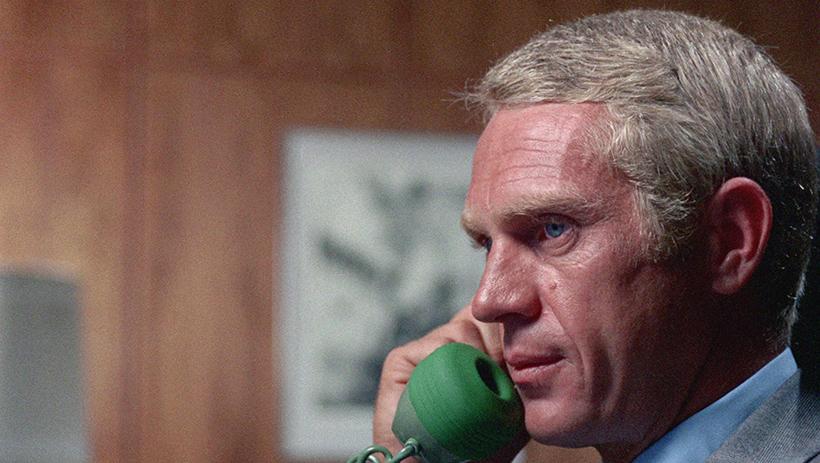
The ultimate maverick of them all was Steve McQueen in The Cincinnati Kid (1965), edited by Hal Ashby, one of Jewison’s personal favorites and the legendary The Thomas Crown Affair (1968). Two sensual, elegant œuvres that involved a great amount of complete improvisation on set, choreographed by McQueen’s agile physique. Hymns to freedom–whether it’s the freedom to lose everything or to win it all–grace took the place of morality. These films send the message that the sky’s the limit!
AFRICAN AMERICAN
Adopting New York as his home, Jewison had served in the Royal Canadian Navy from 1944 to 1945. Upon his return, he traveled through the southern US states, where he discovered the living conditions of African Americans, which became a central theme in his œuvre. Thanks to his accessible approach to storytelling, he was able to raise awareness in America about the trauma of segregation (and other social issues.) In the Heat of the Night (1967), one of his finest works and a massive commercial success, an African American cop from the North (Sidney Poitier, riveting) comes face to face with a white cop from the South (Rod Steiger, outstanding). Eventually, they’re forced to work together to solve the same case in Mississippi. Jewison drew on his brief acting experience to encourage improvisation among his cast members. The intense gazes, the impulsive moments that gradually subside into stillness, and the suspense all go a long way toward showing that all men are equal and deserving of equal rights. The filmmaker would return to this fundamental theme in A Soldier’s Story (1984) and The Hurricane (1999).
INSPIRATIONS
François Truffaut, Fred Zinnemann and William Wyler.
JANE FONDA
Jewison was certainly impossible to put in a box. In 1978, settled on his farm in Canada, raising cattle and making maple syrup, even though he had already won Academy Awards, BAFTAs and Emmys, he set his sights on unique projects like the masterful Agnes of God (1985). The maverick is a woman this time, portrayed by Jane Fonda, luminous and reflective, who investigates in a convent. It’s proof that Jewison was capable of taking on anything!
Virginie Apiou