

© DR
RETROSPECTIVE
Scola’s Italy–what a laugh!
POSTED ON 14.10.2026
Given the richness of his inspiration and the variety of his perspectives on society, Ettore Scola could single-handedly represent Italian cinema from the 1960s to the 1980s. The rediscovery of his work seems endlessly rewarding.
Before becoming one of Italy’s leading filmmakers, Ettore Scola (1931–2016) was a meticulous and gifted screenwriter. Trained in the art of comedy as a cartoonist for the satirical newspaper Marc’Aurelio (like Federico Fellini before him), he learned to capture and then immortalize the flaws of his era, before being pulled into the world of cinema as the auteur of some twenty films. For instance, he co-penned The Easy Life with his friend Dino Risi (1962), painting a biting portrait of Italy where the energy of economic development generated a certain selfishness and non-accountability.
Love as a sign of social status… Starting with his début film, centered on relationships, Let’s Talk About Women (1964), Scola proved to be “highly sensitive to the issue of women’s place in society,” wrote Charles Beaud*. Then followed The Pizza Triangle/Jealousy, Italian Style (1970), which also includes a political dimension. The story follows a florist (Monica Vitti) and her aspirations, in love both with a bricklayer (Marcello Mastroianni) and a pizza chef (Giancarlo Giannini). The couples end up as failed love stories due to social conventions. With We All Loved Each Other So Much (1974), Scola considerably widens the scope: three former Resistance fighters, bound by friendship and in love with the same woman, traverse thirty years of Italian history. Their youthful ideals are uprooted by the compromises and sacrifices that adulthood demands. “We wanted to change the world, but the world changed us.” The phrase sums it up in a nutshell, with the bitter taste of a failed utopia. Yet Ettore Scola always returns with tenderness, merited by those who believed in it… including himself.
Satire flies without a safety net. In Ugly, Dirty and Bad (1976), Scola crafts a cynical farce: in a Roman slum, a large family wages a relentless battle over the million-dollar inheritance of an elderly, one-eyed patriarch. The film portrays poverty in a way that makes one want to laugh, but through clenched teeth. Garnering an award at Cannes for its direction, the film was a box-office flop. The mirror it held up was decidedly too unflattering for Italians.
Scola once again questions his ideals in The Terrace (1980). At a party in Rome, friendly conversations flow among actors, a screenwriter and a producer… Personal crises and political disillusionment depict a left-wing party in severe distress. “Autopsy of an intelligentsia out of steam,” commented Jean de Baroncelli in Le Monde. “The Terrace is undoubtedly the most uninhibited film of my career (...) Because for the first time, I’m talking about myself, a left-wing intellectual”.
A Special Day (1977) is, finally, the finest example of Scola’s art: he captures an entire era in a single encounter. On 8 May, 1938, all of Rome is out celebrating Hitler’s visit to Mussolini. At home, a housewife (Sophia Loren) meets her homosexual neighbour (Marcello Mastroianni). Two people in a dire state of isolation are outcast to the margins of society. In an empty building, they discover the meaning of solidarity. So as grand history plays out as a backdrop, it is the touching, intimate story that tears everything apart.
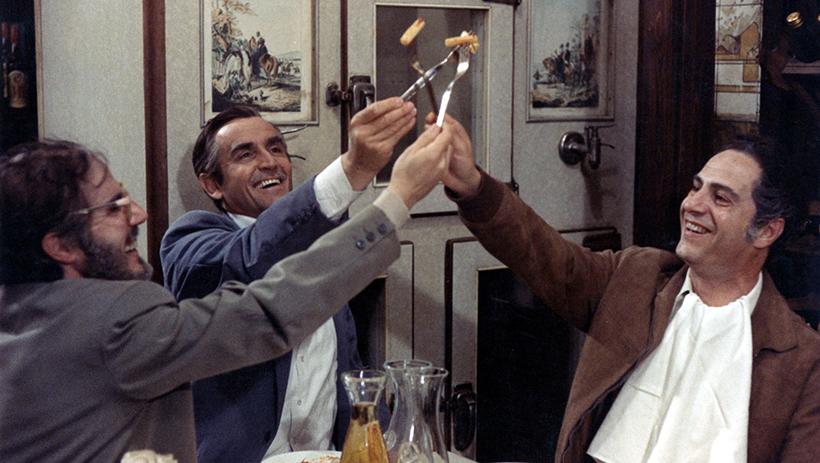
Time goes by, but cinema endures. In The Most Wonderful Evening of My Life (1972), a con man finds himself in a castle where a dinner party turns into a trial. Between laughter and chills, we discover Scola’s philosophical side. Splendor (1989) is a contemplation on his craft, as he creates a story of a movie theater threatened with closure. Our memories would vanish along with it… Later, in What Time is It (1989), the director narrows the focus even further, examining a relationship between a father (an eternally magnificent Mastroianni) and his son (Massimo Troisi). Just one day spent together is enough to ascertain the vast gulf between their respective views on ambition. And as is the case with all of Scola’s œuvre, his characters ultimately end up revealing something about ourselves.
Carlos Gomez