
MIFC-ENCOUNTER
Shivendrah Singh Dungarpur
POSTED ON 15.10.2026
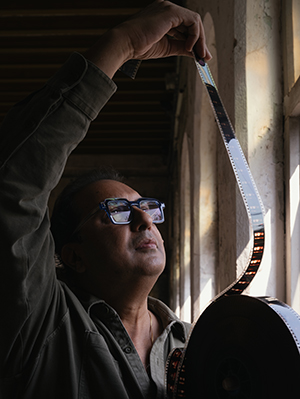
Shivendrah Singh Dungarpur, founding director of the Film Heritage Foundation and a precursor in the preservation of India’s film heritage, joins us in Lyon.
«Of the 1,338 Indian silent films, only 29 still exist!»
© DR
What exactly does your work entail?
In 2014, I founded the Film Heritage Foundation, a nonprofit organization devoted to the preservation and restoration of India’s film heritage. At the time, nothing of the kind existed, and Indian films were disappearing on a daily basis. It was a cultural emergency. Over the years, we’ve raised awareness among cultural institutions and film festivals about our heritage, which encompasses films from Sri Lanka, Nepal and Bangladesh as well. We’ve also trained archivists in Bhutan, Afghanistan, Turkey, Egypt and the Middle East.
Eleven years down the road, what is the foundation’s current status?
Today, the foundation has preserved 700 films on celluloid, 200,000 artefacts, cameras… and our restored films are screened at festivals in Berlin, Cannes, Venice, Toronto, Lyon and London. Through these works, we are preserving cultures and languages that must not be forgotten. The history of Indian cinema began in 1913 with Dadasaheb Phalke’s film, Raja Harishchandra; only a fragment remains. Of the 1,338 Indian silent pictures, only 29 still exist! The situation is not much better for sound films. It has been estimated that we have lost between 70 and 80 per cent of our heritage. Today, India produces over 2,000 films a year in 30 languages across nine regions and has created countless film industries, where we get involved by running workshops.
Please tell us about the MAMI Mumbai Film Festival, of which you were the director until 2024.
Founded in 1997, it’s South Asia’s first festival to promote vibrant, independent Indian cinema on the big screen. I believe in the collective experience of cinema screenings as a way of introducing audiences to lesser-known works.
What does Lyon mean to you?
This is my first time in Lyon, the birthplace of cinema. There’s no better place to screen the restored version of one of our finest films, The Pure One. Every day on my way to work, I walk past Watson’s Hotel (now Esplanade Mansion), where the Lumière operators held India’s first film screening using the Cinematograph in Bombay (today’s Mumbai) on July 7, 1896.
Which French filmmakers are a key part of your film culture?
I’m familiar with the great masters: Gance, Renoir, Carné, Bresson, Tati and all the New Wave filmmakers. If I had to choose my favorite filmmaker, it would be Jean-Pierre Melville for his poetic approach to genre cinema and his independent way of making films. That’s what I dream of doing!
Interview by Virginie Apiou