
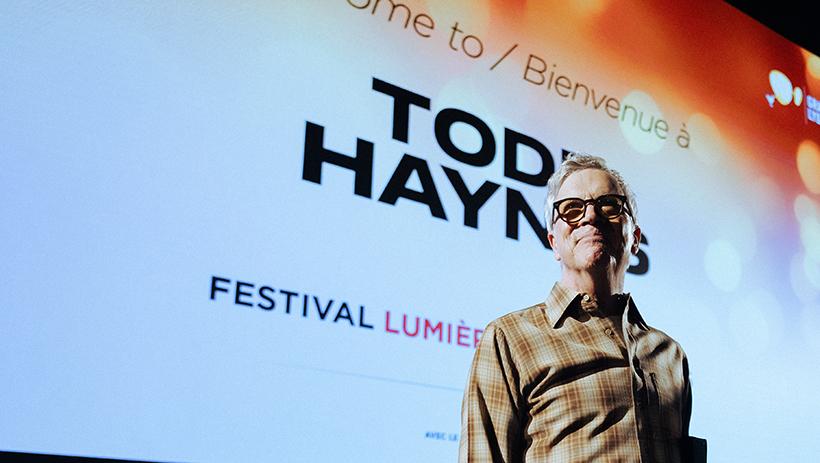
© Léa Rener - Institut Lumière
MASTER CLASS
Todd Haynes
POSTED ON 14.10.2026
From his pivotal meeting with producer Christine Vachon to the preparations for his new film De Noche and his fascination with illness, American filmmaker Todd Haynes spoke candidly to the audience at the Pathé Bellecour. Highlights.
Without Christine Vachon, my film Safe wouldn’t exist."
His method: the picture book
When I’m preparing for a shoot, I gather together films according to the same themes, from all eras and genres. It’s as if I’m setting up a mission. I launch research studies, which give me the chance to immerse myself in a subject and explore what I want to relate. Based on this step, I put together a picture book that I share with my whole team, allowing me to visually communicate my vision for the film. Many directors work this way.
An obsession with disease
I arrived in New York in 1986, when the AIDS epidemic was in full swing. We realized that something very serious was happening, but we were completely lost. It was around that time, in fact, that I met my producer, Christine Vachon. Together, we immediately became involved in the fight against AIDS with the organization Act Up. The disease and treatment all became a part of our lives, and therefore part of our films. In one of my first movies, Superstar: The Karen Carpenter Story, disease was already a theme, relating the tragic story of singer Karen Carpenter’s battle with anorexia.
Thank you, Mary Poppins and Douglas Sirk
I saw Mary Poppins when I was three and was hooked! It sparked a desire to create within me. I immediately started sketching and dressed my mom up as Mary Poppins. At that moment, I realized that creating had become essential to me. After that, I became fascinated by a genre of films I discovered in middle school: melodramas. Filmmakers like Douglas Sirk, Rainer Werner Fassbinder and Max Ophüls inspired me. They were all European intellectuals who had studied theater and film.
Bowie and Androgyny
The idea for the film Velvet Goldmine came from a desire to explore the theme of homosexuality amidst a backdrop of glam rock. It was a movement from the late 1960s that originated in the United States and England, a time when everyone was challenging gender norms. Androgyny has always existed, but David Bowie took it a step further. And I think it resonated perfectly with how teens felt at the time; those who felt they were “in-between” so to speak. What’s great is that this ambiguity became normalized at the time–it was wonderful.
Christine Vachon, sparring-partner
We met when we were students in New York. I can still picture us watching my film Superstar: The Karen Carpenter Story on the futon in my living room. Immediately afterwards, Christine told me: “I want to produce your next film.” She fights every day to ensure that films get made. She’s one of the people who has helped raise the visibility of queer cinema. For my film Safe, we needed a million dollars; it was very difficult to find the necessary funding. I almost gave up, but Christine went back to the trenches... Without her, this film wouldn’t exist!
Laura Lépine