
© Léa Rener Institut Lumière
MASTER CLASS
"What if we gave women the power to decide on peace?"
POSTED ON 16.10.2026
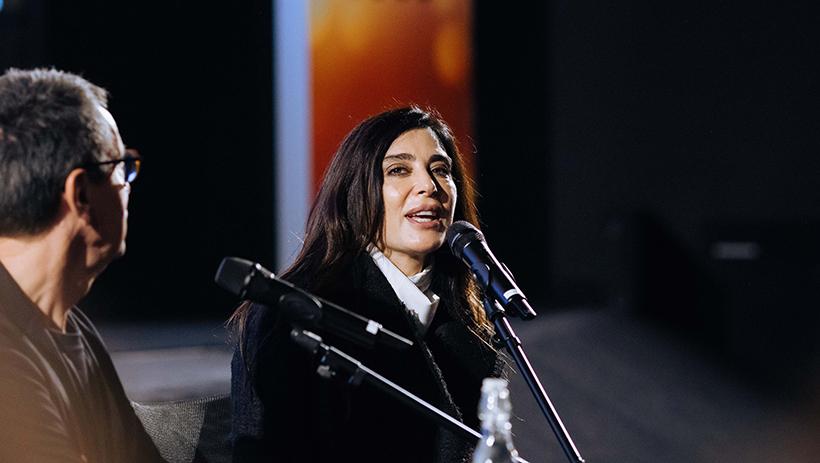
Lebanese filmmaker and actress Nadine Labaki spoke candidly to the audience at the Pathé Bellecour. Moving, funny and sincere, the encounter perfectly reflected her personality.
Cinema as an escape
I’m what you might call a child of war: which means that for periods of time there’s no school, you cannot play and you are forced to be holed up behind sandbags. The only escape was through film and television. We lived right behind a VHS store, and we’d sneak into the shop to watch movies. They were our key to discovering the world. I realized from a young age that I wanted to be a storyteller. My grandfather rented a movie theater, and I can still recall my father describing the smell of the film reels to me. It was kind of like Cinema Paradiso the way he told me about it. I knew I wanted to make films, but it seemed like an impossible dream. In class, the teacher would always say, “See that tiny, invisible dot on the map? That’s Lebanon.” So we always felt like no matter what we’d do, things would be challenging.
A Grease fan
As a child, I watched everything that was on TV, from series like Dallas and Dynasty, to films, mostly musical comedies. Grease is one of my favorite movies–I watched the VHS tape until it stopped working! I also watched a lot of Egyptian and American movies. The first film that really made an impression on me was Bambi, with its exploration of death, something I was already conscious of.
Ad culture
I studied audiovisual arts at Saint-Joseph University in Beirut; it was a brand-new program at the time, and I think we were the second or third graduating class. After that, I knew I wouldn’t have the option of going straight into filmmaking, so I decided to start with advertising; it was my laboratory. Through that, I was also able to experiment with directing actors. Advertising was my first training ground. I then directed several music videos: that’s where I was able to turn my frustration into something positive: I could show women who were free, unburdened by their body image. And I think I also had the audacity to say I knew what I was doing, even when this wasn’t the case.
Fairy Godmother Anne-Dominique Toussaint
We met in 2003 at a film festival in Beirut. At the time, I was heavily involved in making music videos, but I’d always wanted to make films. A producer, Anne-Dominique Toussaint, was there to introduce Emanuele Crialese’s film Respiro. A mutual friend introduced us after the screening. We chatted for ten minutes, and then she said to me, “Nadine, I want to support you.” I hadn’t even written my first film, Caramel, yet! She advised me to write a synopsis for the Cannes Film Festival’s Cinéfondation. We wrote that text in three days, not believing it would work at all. A few months later, I got a call telling me the film had been accepted into the Cinéfondation. I couldn’t believe it–it was a miracle!
The Caramel story
I always sensed a disconnect between what women around me had become and what they wished they could have been. I wanted to understand why they couldn’t find fulfillment: and that question was the inspiration behind Caramel, my first film. I set the story in a beauty salon because it’s a place of intimacy, where people confide in one another and talk freely. And it was also a time when Beirut was brighter than it is now. A few days after we finished filming Caramel, the 2006 war broke out, and since then, the situation in Lebanon has continued to deteriorate. This film bears witness to a Beirut that is no longer the same.
The dream-reality of Cannes
Having a film selected for Cannes is normally an unattainable dream. But it’s odd–I had a sort of vision about the screening of the film Caramel at Cannes a few years earlier. I was an audiovisual student at the time, and I imagined myself in a huge movie theater, with people applauding a film whose credits listed my name as the director, and I was standing next to the film’s composer. When it was screened at the Directors’ Fortnight in Cannes in 2007, that’s exactly what happened: I was in that theater, watching the credits roll for my film, alongside the film’s composer, who would eventually become my husband, musician Khaled Mouzanar! When we talk about faith or the law of attraction, it really reflects what happened. It was incredible to see that a Lebanese film could be distributed in so many countries. And the film received a very enthusiastic reception in Lebanon.
In search of Truth
It’s often out of a desire for authenticity that I like to work with non-professional actors. I ask them to be themselves, not to act. I need my actors to make the scene and the dialogue their own; I draw a lot of inspiration from who they are in real life. When I’m filming, I start with something solid, the script, and then gradually let life in. It’s like a door opening little by little. I’m always on the lookout for that truth!
Where Do We Go Now ?
The writing of the film took place at a particular moment; the situation in Lebanon was deteriorating more and more, and we were on the brink of a new war. I was pregnant with my son, and I found myself thinking, “If he were eighteen today, how would you have prevented him from taking up a weapon to kill another young man?” And that’s where the idea for the film came from. In this story, we ask ourselves, “What if we gave women the power to decide on peace?” Faced with the absurdity of war, I decided to push that absurdity further and inject it with humor, like a fable.
The harsh reception of Capernaum
The reviews of the film Capernaum were very scathing; it was truly traumatic. I saw cruel terms used, such as “pornography of poverty.” I didn’t understand why those descriptions were used. What does that even mean? That we must sugarcoat things when depicting the reality of street children? This experience with the criticism even made me question my original motivation for making the film. My aim from the start was to say that we cannot look away from the situation of these children in Lebanon. You know, when you’re faced with these attacks from certain critics, you even start to doubt your own convictions. I went to therapy after this experience, and I’m not even sure I’ve fully recovered from it yet.
Organized chaos
While filming Capernaum I knew it would take time to adopt to the children’s pace. We all felt like we were on a mission; the shoot was difficult and demanding to that extent. I think we were guided by a higher power. It was organized chaos. My daughter was eight months old then, and I remember carrying her in a baby carrier attached to my monitor so I could move quickly between scenes. Since then, the film has enjoyed incredible success with audiences. And something extraordinary also happened when the film was released. The United Nations took an interest in the case of young Zain al-Rafeea, the boy who plays the lead role in the film. They helped his family settle in Norway, where he lives today, studying equine science.
The next screenplay is done!
A few days ago, I wrote the word “THE END” on the script for my next film. It will deal with the theme of womanhood in a universal way: we’ll tell several stories about women from different cultures at key moments in their lives. It will be a bit like an epic saga. But I can’t say more than that…
Reported by Laura Lépine