
© Lucas Aymard - Jean Luc Mège Photography - Institut Lumière
MASTER CLASS
"You should always see your projects through to the end, no matter what happens!"
POSTED ON 16.10.2026
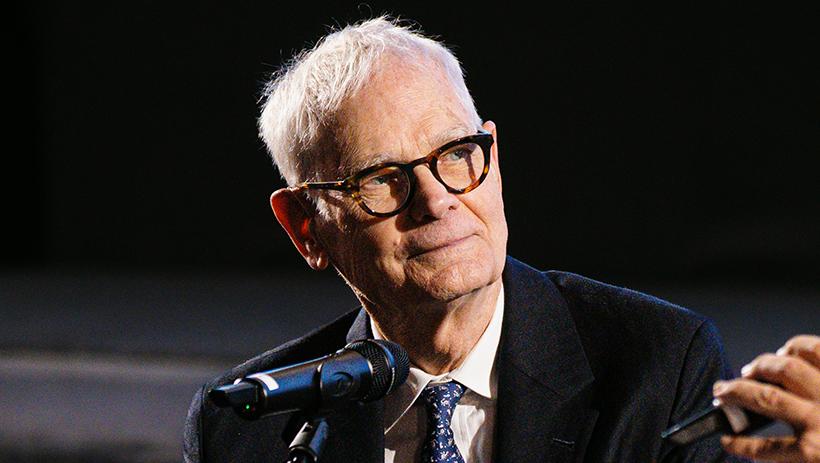
A maestro of visual arts, American cinematographer Caleb Deschanel communicated his passion to the audience with his characteristic wit and a touch of humor. Highlights.
His calling
I started out studying biology because I come from a family of doctors. But I didn’t really like the other students. When I missed a class, no one wanted to share their notes; it was very competitive. Then one day, while wandering through the college hallways, I stumbled upon an art workshop, and I was fascinated. I thought to myself, “What could be better than sitting in the dark and looking at works of art ?!”
The coolest college class!
I met some incredible students at the University of Southern California (USC), such as Walter Murch, who went on to become one of the top film editors. Also in our class were future screenwriter Matthew Robbins and director George Lucas. During that time, I had the opportunity to work with a cinematographer, and that’s when I knew I wanted to pursue that career. Since I’d learned how to work with lighting, all these incredible students would call on me for their school films. Back then, we had limited access to the university building to shoot our films, so we’d climb on trash cans to sneak into the facilities, and as a result, we ended up making better films than the other students! George Lucas was even craftier; he’d steal film reels from Navy students who had more resources than we did. He was already one step ahead!
The Nouvelle vague
My biggest influence is the French New Wave with all those incredible filmmakers like Jean-Luc Godard and François Truffaut. What’s great about French New Wave films is that watching them made us realize it was possible to make films like that. In reality, if you have a story, you can make a movie. You don’t need a huge crew, special effects or massive resources. Watching Hollywood movies, I’d think to myself, “This is a bit too much.” It was really the French films that made me want to get into filmmaking.
His collaboration with Caroll Ballard
I met Caroll when he was a student at the University of Los Angeles with Francis Ford Coppola. On the set of The Black Stallion, we started out working in Toronto with a TV crew. It was difficult because they always want to do things very quickly, and Caroll and I like to take our time with each shot. Then we filmed the second part of the movie in Italy, and things were much better because we had a crew of technicians who worked the same way we did. In fact, I met Federico Fellini thanks to that shoot in Italy. There’s one essential thing I learned on that shoot: you can do all the preparation in the world, draw up piles of storyboards, but the image is created on set.
What makes a good director ?
There’s no rule–some filmmakers shoot just one take, like William Friedkin, while others shoot hundreds of takes, like Stanley Kubrick or Warren Beatty. You know, I don’t believe in the concept of a “beautiful shot.” Kubrick explained that a shot serves to visually convey what the character is feeling. But the main thing is how you use those shots to capture the character’s emotion. Cinematography is made up of three simple elements: day, night the sun. My job is to use this trio of things to convey emotions. In Barry Levinson’s The Natural, there’s this baseball game scene where Robert Redford steps up to bat and hits the ball, causing all the floodlights to explode–it’s like fireworks, and you realize he’d won the game. No one has ever told me, “That could never happen in real life.” What I’m trying to do is guide you through the film’s story.
Secrets to being a good cinematographer
Sometimes you have to be willing to put yourself out there, to make a fool of yourself, to get what you want. I’ll do whatever it takes to do my job. A few years ago, I wanted to make a documentary about trains. And to do that, you need permits: I received rejections by mail from three railroad companies. Each letter followed the same format: the first paragraph thanked me for my interest in the company, the second announced their refusal, and the third wished me good luck with the film. One day, I went directly to a railroad’s website: the guy in charge, by some miracle, didn’t read the second paragraph and let me film. So I was able to make that documentary. All I’m trying to say that you should always see your projects through to the end, no matter what happens. There’s also another very important thing: take the time to observe. Whenever I’m in a café, I watch the people around me and observe the light. My wife and I love playing a game where we’re people watching and we make up stories about them. Life is the best teacher when it comes to learning how to tell stories.
Reported by Laura Lépine