
© DR
ENCOUNTER
From childhood
POSTED LE 17.10.2026
“As a child, Wim Wenders only knew of the ruins of Germany, of his country that had been destroyed after WWII: ‘That was my world.’”
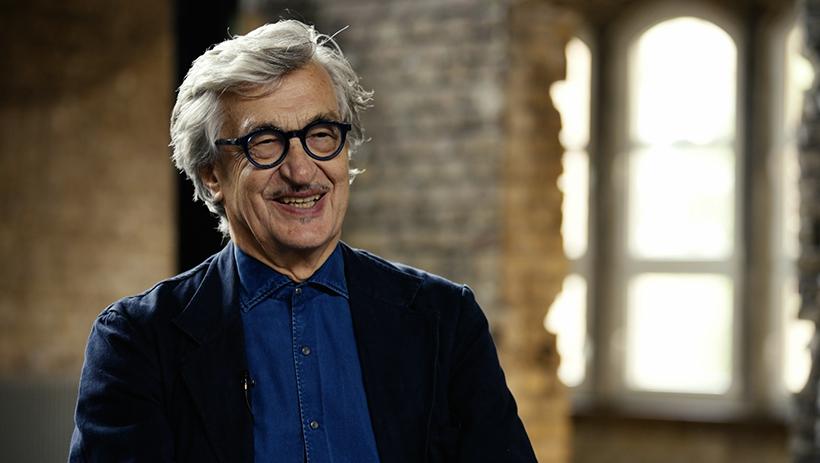
This quotation is an excerpt from The First Image, a highly original documentary which focuses on the early careers of great filmmakers. In the segment dedicated to Wim Wenders, we go from one discovery to the next, each equally wonderful and addictive. We’d gladly spend a long while in the company of this leading director, who suddenly reveals that he has so much faith in cinema when it’s marvelous, that he starts dreaming in front of the screen: “I fell asleep because I had so much confidence.” The creator and director of this remarkable series, Pierre-Henri Gibert, recalls his meeting with the 2023 Lumière Award recipient.
What does Wim Wenders mean to you?
My love of cinema developed when I was a teenager, centered around Wenders. He suddenly embodied a kind of European cultural beacon that reached out to the world, a guiding light that unconsciously spoke to me through all those themes of emptiness, of inhabiting the world and of finding one’s place within it as a viewer. There’s something extraordinary about him; he creates a space we can go to with our broken hearts, our burnouts, our doubts. And we’re received with gentleness. In a certain sense, he reconnects us to the world, very simply, just through his approach, thanks to a certain perception. Little things that might seem completely trivial become something worth seeing, strange and funny at times. Life gains a real depth, and it becomes quite extraordinary to be in the world. Especially when solitary characters end up connecting with one another, it does you a world of good.
Tell us about Wenders’ first film, Summer in the City.
What was surprising was that no one knows Wenders' first film, Summer in the City (1970), for one simple reason: it was basically never screened. Wenders didn't own the rights to the music he wanted, so he opted not to release the film. This is just one of the many paradoxes of Wim Wenders. He seems so easygoing, yet he possesses this force, coupled with extraordinary artistic discipline.
Does his cinema reflect his personality?
Yes. Wenders abandons himself to the world; he’s very open to things, which is very moving. That infuses his films with a kind of suspense; you never know where you’re headed. And when you rediscover Summer in the City, it’s extraordinary because it contains all the keys to his entire future œuvre. There’s a truly amazing uncompromising quality to it. And the dedication he shows to this early work, with his continued desire to restore it and screen it, really touches me. It’s a kind of inner strength and self-confidence that’s very spectacular, after all.
What stood out to you about his presence on set during filming?
He walked in, and it felt like a kind of natural, accessible presence. We hadn’t even started the interview when suddenly he spotted a beautiful shadow cast on the wall. Bam! He stopped short and snapped a photo. At that moment, I realized we were already in Wenders territory, which is altogether fascinating. He’s someone who’s fully present, with whom a connection feels effortless. It did more than just surprise me –it won me over. What touches and moves me overall is the strength and confidence he has in cinema and in the audience’s ability to connect with his world. It’s an act of faith that I find extraordinary. He can go off to shoot a film without knowing what he’s going to shoot, convinced that it’s all going to work out perfectly every day, thanks to his openness to whatever comes his way… He’ll find what he wants to film. He succeeds because that is who he is, because there’s something truly profoundly sincere about his approach. It really inspires admiration, and of course it renders every one of his movements and gestures heroic.
Reported by Virginie Apiou