

© DR
THE IT GIRL
Her life is a novel
POSTED ON 15.10.2026
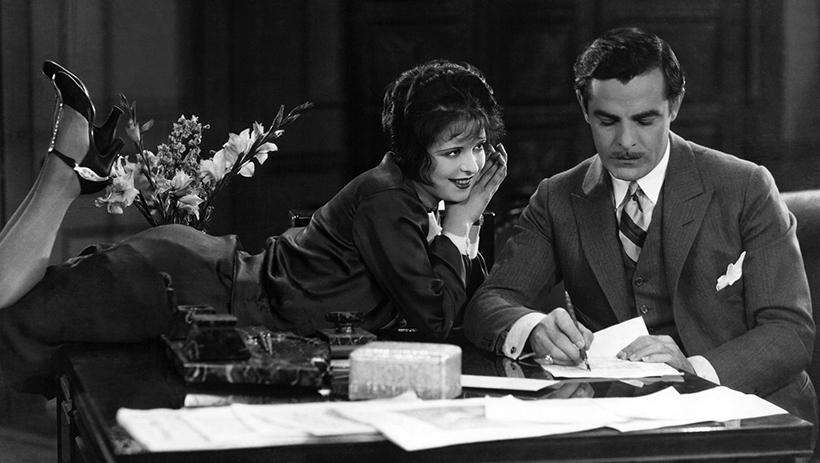
“I’m a sideshow in Hollywood,” declared Clara Bow. Indeed, the young actress led a life unlike any other. As famous in her heyday to the same degree that Margot Robbie is today (the former served as the inspiration for the protagonist in Damien Chazelle’s Babylon), Bow was the original blueprint of the “It Girl,” a term more ubiquitous than ever today, a century later. Film historian Martin Barnier shares his insight…
Who was Clara Bow?
A natural star who made her mark despite no theatre experience or training whatsoever, at the age of sixteen! She was a presence entirely at home on the silver screen, with uncanny charismatic power.
In what way was she a genius of the silent film era?
She starred in far more silent films than talkies. For her, cinema was all about action: using her physique, going to and fro, revealing her expressions and incessantly in motion–fundamental abilities of silent pictures. Her masterful control of her body enabled her to express exactly what was asked of her. Every silent flick filmmaker who worked with her was able to elicit the exact emotions required for each scene. Her most prolific period, the silent era, is truly what made her a star.
How did the advent of talkies affect her career?
Clara Bow was terrified that she would not succeed the transition to sound. She was under so much pressure from the studios that she kept stacks of bottles of tranquillizers at home. She even went as far as to speak disparagingly about her own voice to Paramount! Yet her voice was deep, melodious and lively. She sang admirably, for instance, especially in musical comedies.
Would you say she lived a life as if it were a novel?
One could say that. She had a childhood devoid of affection and characterized by extreme poverty. Her mother was sickly and worked as a prostitute at times. She died very young. Her father was a negligent cad who raped her. She had to fend for herself both at home and at school, where she was made fun of because of her clothes. She was physically combative and earned a reputation as a tomboy. The end of her life was challenging; she developed a complete phobia of the world. It was also likely due to the sensationalized press who invented romantic and sexual stories about her based on her screen roles. In Hula, for example, she plays a young woman who is totally free. In the initial scene, she bathes in the nude, and her breasts are visible. Then she rides a horse, clad in trousers and pressures a married man she loves to get a divorce. She is the It Girl with that certain je ne sais quoiquality that makes her irresistible. Her vitality, joyousness and natural radiance were never feigned. She was the flapper, the garconne (short hairstyle, drop-waist frocks…) of the Roaring Twenties. From 16 to 25, Bow led an incredibly active life of parties, gambling and alcohol. Clara Bow symbolizes the stark contrast between traumatizing violence and overwhelming professional success.
Tell us about Clarence G. Badger’s It.
In the film, Bow embodies the very definition of the flapper, the epitome of the independent young woman driven by a quest for unbridled pleasure. She also represented the vulnerability of adolescence, but with an overriding zest for life that nothing could dampen. In 1927, at age 21, her sexual intensity was too much for most, but her suffering was just as acute; the two became indistinguishable. It’s fascinating to ponder what the situation reveals about a point in life, when one refuses to be confined to a box.
What makes her a modern-day celebrity?
These films are timeless. Between 1927 and 1934, during the pre-Hays Code era, social mores were more liberal, and there were already modern elements in cinema, particularly in Clara Bow’s films. They are perfectly suited to today’s audience; they address powerful aspects of life, such as sexuality and the expression of the body, which was so prevalent in that era of silent film. Bow lived the life of a young woman, with all her passionate emotions. Today, nobody would find anything shocking about that!
Interview by Virginie Apiou