
© Wild Bunch - Block 2 - Jet Tone Production - Sil-Metropole Organisation / DR
Without a Net
Zhang Ziyi, a Sense of Balance
POSTED ON 10.10.2026
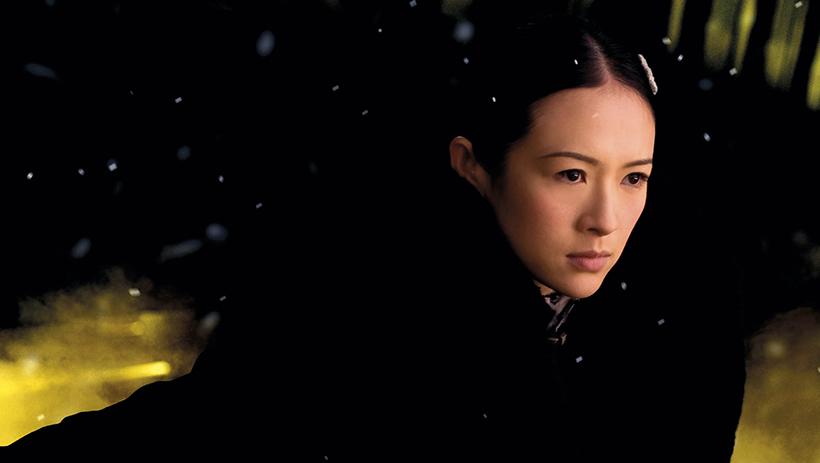
Guest of honor of the Wo hu cang long/Crouching Tiger, Hidden Dragon screening at the Halle Tony Garnier and a master class, the Chinese star has led her career like a vertiginous tightrope walk in a myriad of ways.
From the very outset, Zhang Ziyi’s life seems to hang by a thread, literally. At just twenty years old, on the set of Wo hu cang long/Crouching Tiger, Hidden Dragon (2000), a sword and martial arts action extravaganza, she spends her days harnessed to cables hanging from the studio’s roof. While she dedicates two months to mastering the art of choreographic swordplay, Ang Lee teaches her to shout during fight scenes, to project a strong female lead. When the film, a worldwide smash hit, is released, audiences hail her as a major figure of wuxia cinema. How does one achieve such legendary status without even striving for it?
The daughter of an accountant and a schoolteacher, Zhang Ziyi has built her acting career across two continents and two cities: Beijing, where she spends years at a dance academy known for its severe discipline, and Hollywood, making a charismatic impression in the action thriller comedy Rush Hour 2 (2001). At age 26 in 2005, she incarnates a geisha for the leading role in the adapted film of the bestseller, Memoirs of a Geisha, and years later, she plays a character in the fantasy flick The Cloverfield Paradox (2018).
Floating weightlessly to the point of dizziness, Zhang Ziyi also finds herself hovering between three filmmakers whose uniquely distinct universes she embraces. Zhang Yimou is the first to discover her at nineteen, upon graduation from dance school, and he quite literally pushes her into The Road Home, released in 1999. Shortly thereafter, in the fateful call that changes everything, Zhang Yimou picks up the phone to convince Ang Lee to give her an audition. Then, Wong Kar-wai directs her in works 2046 and The Grandmaster, devoid of script, she must improvise. She undertakes the experience and the experimental, involving therapy and cinema in equal measure. In The Grandmaster, Zhang Ziyi partially marks a return to action film, opposite the poignant Tony Leung, enveloped by the magnificent elegance of Wong Kar-wai’s cinema. The picture highlights Zhang Ziyi’s subtlety of craft—capable of fighting bare-handed against the man she loves, as if engaging in a love scene full of modesty and emotion.
This incessant high-wire act has led Zhang Ziyi to achieve a final form of balance, the perfect dichotomy between the dreamlike icon one sees on screen vs. the woman who is determined not to conform to that image. We view her as unattainable, elusive, observing the face that seems impossible to read with its enigmatic smile, yet she is simply reserved. After the global laudatory praise for Wo hu cang long/Crouching Tiger, Hidden Dragon, she can entertain a flurry of roles tailored for international audiences, but does the opposite, refusing most of the offers, “which reduces her to parts of playing the victim.” What interests Zhang Ziyi regarding her acting? “Giving shape to emotions,” she replies. It is perhaps for this reason, that in 2021, she chooses to portray a Chinese factory worker, who is also a loving wife and mother of two in China of 1969, for the short film Poem, which she also directed!
Twenty-five years ago, the artist whom Lyon is preparing to celebrate lit up the screen, hanging by a thread. But her personality ensures she will never become a puppet.
Carlos Gomez